donderdag 2 april 2020

Miraculous Abundace at the Bec Hellouin Farm

A recommendation for the book Miraculous Abundance about the Bec Hellouin farm in France.
I am sure some of you might have heard of the farm, perhaps through the English translation of their scientific article that proves it is economically feasible to work the way they do without big machinery. See the Permaculture Research Institute: Diversified Organic Market Gardening and Arboriculture .
They are surely one of the best examples of a temperate climate permaculture farm. What is especially interesting is how they integrated bio-intensive methods and other things into permaculture design.


In the book Charles Hervé-Gruyer describes his journey of his live and how he and his wife Perrine started the Ferme de Bec Hellouin, with all the trials and tribulations, and successes, that arose in the process. They describe all the various agricultural systems they tried and tested such as permaculture, bio-intensive, bio-dynamic, Fukuoka’s and Holzer’s natural farming, etc. It is a good introduction to all of these, yet refrains from too much technical descriptions of the actual know how. They say they planned another book that will describe the Bec Hellouin method in detail, which has now already been published in French 'Living with the Earth / Vivre avec la Terra'. You can order the book at Chelsea Green Publishers. I collected some good quotes from the book. * We then reflected deeply on how to synthesize the many “good practices” gleaned along the way in a permacultural framework. This led to the Bec Hellouin farm method, which highlights the elements we see as essential to building an economically viable agriculture and permaculture likely to contribute to the regeneration of the environment. This twenty-point method continues to evolve. We personally have not invented anything; our only merit is to have foraged from various sources, then tested and consistently organized multiple approaches. Permaculture is a formidable tool for this. * Permaculture has everything to gain by enlisting the approaches of Jeavons, and vice versa. In my humble opinion, the GROW BIOINTENSIVE method can be enriched by permaculture concepts. Some important points—the overall design of the garden, microclimates, the role of trees and water, the benefits of a permanent mulch, and more—are touched on either briefly or not at all by Jeavons. Perrine and I tried to incorporate the wonderful techniques of biointensive microagriculture in the broader context that permaculture offers, and the results have proven very satisfactory. * Likewise, we lay straw or mulch around our crops, as did market gardeners in the nineteenth century. Cutting nettles, picking ferns or reeds, collecting leaves to arrange them between plants is a very time-consuming task. But it is beneficial on many levels, because mulching serves different functions. It protects the soil from direct sunlight, controls weeds, limits the evaporation of water, and fertilizes the soil as it decomposes. If we were to add up the working time saved, from beginning to end, through mulching, weeding, watering, and compost production (which is no longer needed on these plots), we would likely arrive at a total greater than the time it took to mulch. And we have the satisfaction of seeing that, through mulching, our soil becomes more fertile and alive over the years. * Perrine and I are convinced that the most innovative system we put in place in our valley is the forest garden. * A growing number of experts are sounding the alarm bell. If there were a sudden shortage of oil—linked, for example, to a geopolitical event—France would have only a few days of food reserves and could quickly sink into crisis. This may seem surprising to many readers. But yes, the spectre of famine could recur in our developed countries. These nations are far more vulnerable today than before due to the rise of industrial and globalized agriculture, a colossus with feet of clay. That agriculture is based on a highly capital-intensive and centralized model: 80 percent of arable land on the planet used in intensive mechanized agriculture is owned by multi-national corporations. * These are strong reasons to reconsider the power of illusion engendered by the steel monsters that roam our desertified countryside. They are, in the image of the system that produced them, predators. * It is today that we must actively enter a transitional phase; 2030 will be too late! · Traditional agriculture was labor intensive, industrial agriculture is energy intensive, and permaculture-designed systems are information and design intensive. —David Holmgren * In southern France, in the village of Cucugnan, Roland Feuillas makes a “health bread” from ancient grains ground in a stone mill. He has conducted extensive research to find ancient grains with outstanding organoleptic qualities, including local varieties that had disappeared, which he plucked from old thatched roofs. Feuillas cultivates his own no-till grain under layers of mulch. Customers flock to his exceptional breads. * We are convinced that an agricultural transition will not happen without a gradual evolution of the way we feed ourselves. Holding on to our very poor diet stands in the way of the many possible changes in agriculture. Again, it is up to each of us to change our practices, responsibly. Buying industrial food products perpetuates the industrial model. Choosing organic, local, fresh, seasonal products stimulates small-scale family agriculture, accelerating a necessary and enjoyable transition with many benefits at all levels, starting with our taste buds. This healthy and delicious revolution depends on education and awareness; and this, frankly, is a big job. But the movement has begun and like Pupoli with his canoe, each of us must find our favorable vein in its current. * The volumes demanded by a single restaurant are significant and can provide a solid foundation for a market gardener, provided that the relationship is fortified with a contract, as few restaurateurs are truly ready to take into account the constraints of their partnership as Antonin does. This type of partnership is actually not that easy to implement. The chefs have to change their work habits, accept seasonality. The size of the produce is not always uniform. Weather conditions can cause setbacks. But they are rewarded with incomparable freshness and flavor. * Give an individual guaranteed possession of a barren rock, he will transform it into a garden; give him a garden with a nine-year lease, he will turn it into a desert. * The emphasis given to nuts will allow us to combine grain flours with nut flours to make bread, again reducing grain needs. (Nut flour cannot be used alone for bread making.) Increasing use of chestnut flour will be beneficial to human health because of its nutritional power. * The cost of creating a microfarm (from 50,000 to 100,000 euros/$56,500–113,000) / We have estimated the average start-up cost for the creation of a vegetable microfarm to be in the range of 75,000 euros ($84,750).You can start with much less: A small garden and raised beds can be created at a very low cost. The budget of the installation, however, should also include enough to live on for the first few years, until the business takes off. * We strongly advise you to quantify the production of your garden, its economic value, even if only virtual, the time it will take to produce it, the costs to be incurred. For a market garden, when you reach 25 euros ($28) of vegetables per square meter per year, on average, and when each hour of work will generate at least 15 euros ($17) in sales (for all tasks, including maintenance, marketing, management), you can estimate that you have some chance of earning a living (modestly) in the vegetable business * Train yourself as much as possible before you start, rather than after. Our friend Jean-Martin Fortier believes it takes ten thousand hours of work to become a market farmer and this number jives with our experience: This is the fifth year that we have begun to feel at ease confronting the complexity and diversity of tasks. Time invested in training is time gained and money saved. Remember: Permaculture farming is agricultural knowledge. You will not need sophisticated and expensive tools; it is in yourself you should invest!

zaterdag 26 oktober 2019

Environmental issues and Permaculture at a Buddhist Monastery

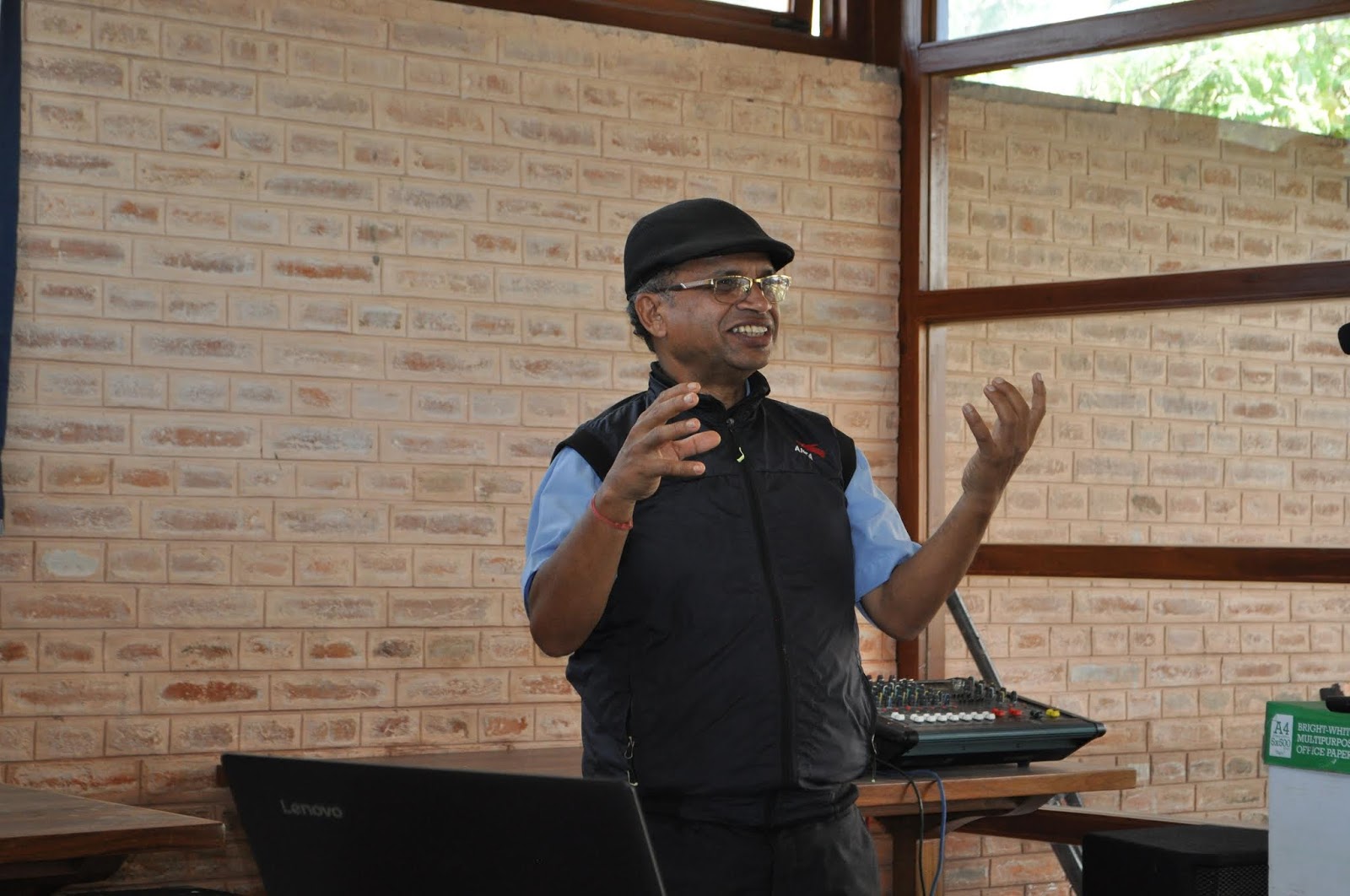
On the invitation of the Rangjung Yeshe student society at Kanying Shedrub Ling, Govinda Sharma gave a an introduction to permaculture at Utpala cafe in Bouddha, Kathmandu.

At the time of the Buddha, monks have famously gone for alms begging in the surrounding villages. There are also instructions found in the Buddhist texts that monasteries should not be build too close to settlements, nor too far away. This rule was obviously purely made for that time's context, where monks and nuns had to walk from the monastery to the village and back each day for alms. When Buddhism moved to other countries, for example China, the situation changed however, and monastics in some monasteries in China had to grow their own food, since going for alms was socially not so much appreciated as compared to the situation in India. In Tibet, at first during the time of the Tibetan empire, the king assigned seven families to take care of each monastic. After the collapse of the empire, in later ages and in some cases up to the present day, monasteries own huge swats of land which are then worked by lay people, very much like the feudal system in Europe, or lamas go out on tours through their area to collect food and funds.

But now we have entered the 21st century, Buddhism has spread around the globe and the situation has changed again. Buddhist communities such as Lerab Ling or Gomde Pyrenees are slowly growing and are becoming large centres. How should such communities be fed? Also, given the current environmental crisis, what is going to be an ethical way (perhaps we can say in accord with the Dharmic principle of not harming) to feed such communities? What is the Buddhist ethics of the 21st century? If we buy all our food from the global market, what environmental impact does that have?

Now of course there are many environmental problems and hopefully also many solutions. As Buddhist, there is no reason to be philosophically invested in one particular solution. To deal with some modern day problems, we might occasionally need modern day solutions. One of them is permaculture. Permaculture can be defined as a "set of design principles centered on whole systems thinking, simulating, or directly utilizing the patterns and resilient features observed in natural ecosystems. It uses these principles in a growing number of fields from regenerative agriculture, rewilding, and community resilience."


Govinda Sharma is one of the top permaculture teachers in Nepal, has over three decades of teaching experience, and also has a degree in organic agriculture from the renowned agricultural university of Wageningen in the Netherlands.

Govinda Sharma

Before starting the lecture Govinda was shown around the Saturday farmers market at Utpala cafe, which is becoming increasingly popular.

Govinda at Himgiri organic hub stand

Govinda talking with leading figures of the monastery Buchung and Shedrub Gyatso

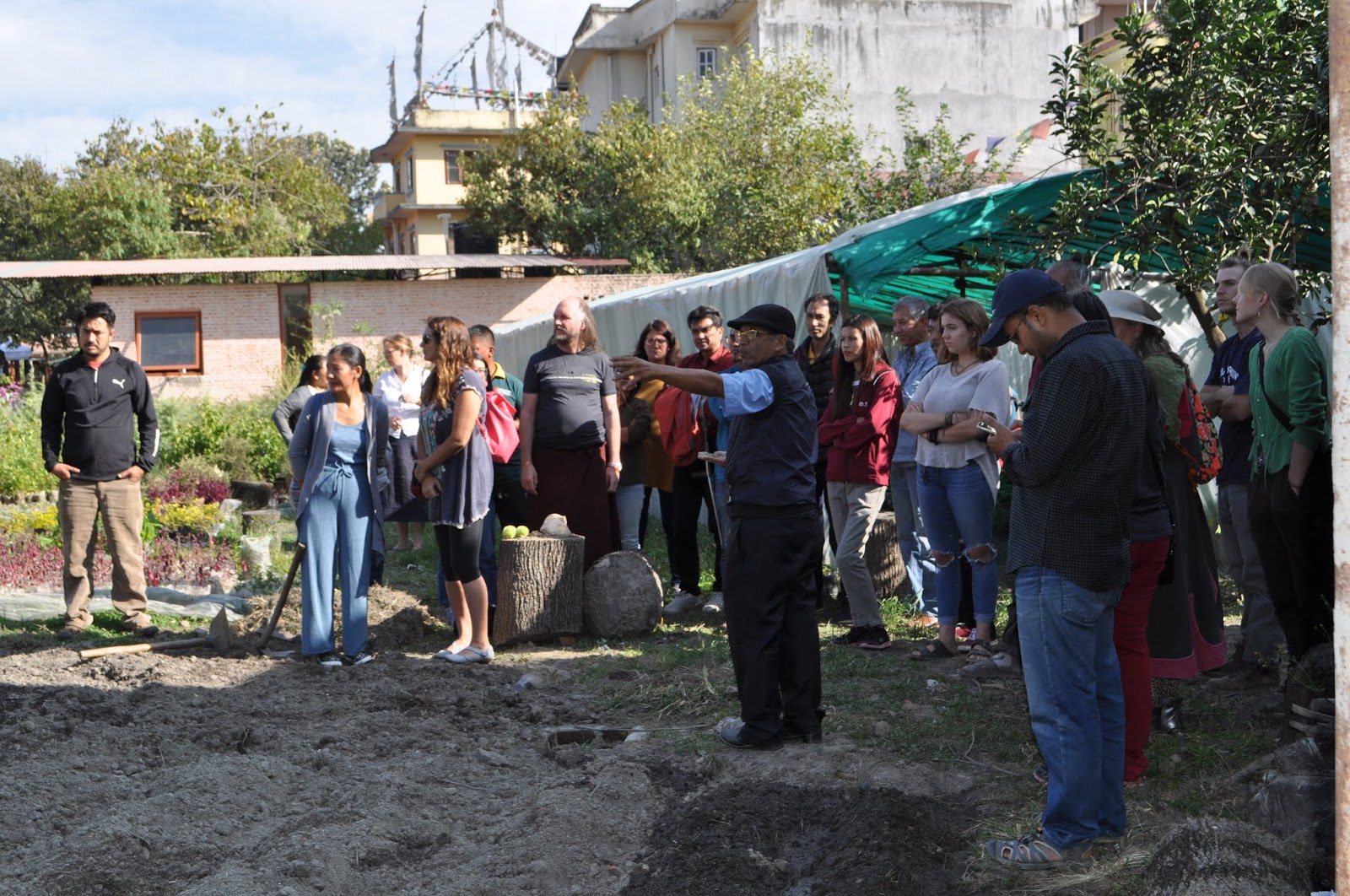
Govinda was also given a tour through the monastery. The monastery is currently exploring the possibility of starting the production of ornamental flowers and food according to permaculture design at a barren plot of land.

Shedrub Gyatso showing the nursery


Inspecting the composting 

This little monk was trilled when a walnut fell out of the tree right in front of him


Then the lecture commenced. The first part of the lecture looked at the question 'why is permaculture needed'? This consisted mostly of looking at a wide variety of ecological problems such as deforestation, massive use of pesticides, eutrophication through an excess of nitrogen, increase of floods and droughts, global warming and so on.

 Eutrophication causes algae to bloom and suffocates all live in aquatic bodies  

In the second part of the lecture Govinda looked more at what permaculture can offer in terms of solutions to these problems. He mainly emphasised that even small things which we can apply immediately in our lives such as refusing plastic bags is also permaculture

A full room at Utpala

The last part of the talk consisted of some practical tips in the field. We looked at soil, sun, water, wind direction and much more. 

In the fields

You can listen to the talk here.

vrijdag 24 augustus 2018

Book review: Karmamudra: The Yoga of Bliss, by Dr. Nida


I’m calling this a book review, but it’s not a real book review. Yet I think this book deserves attention, and I will explain why.

I met Dr. Nida for the first time at a conference on Tibetan Medicine at Shechen Monastery in Nepal. I was taken by his very modern view on things (which is unfortunately often lacking with Tibetan doctors, despite the great potential the system has). For some years I have been slightly skeptical about him as well. How can one teach things like tumo and karmamudra publicly? According to my understanding from the Tibetan Vajrayana tradition, that is not done. But in his book The Yoga of Bliss, Dr. Nida explains very clearly that these are special teachings from the Yuthok Nyingtik tradition. Regarding karmamudra, yes, there are the classical methods (of the third empowerment) which are based on the tsa-lung practices (of the second empowerment). But these are difficult, require years of preparation and training, and so Dr. Nida does not discuss these in the book. Yet Dr. Nida offers a wealth of advice on the topic and places ‘tantric sex’, as it is often called, in the right context. He also discusses exercises that can be done by anyone.

Unfortunately, the topic has been stained with misconceptions and so he starts with dispelling a number of misconceptions, like:

-        -   Karmamudra is so secret it can never be discussed
-        -   Karmamudra is the same as karmasutra
-        -   For karmamudra you need many sexual partners
-        -   Karmamudra is for the purpose of exploiting women
-        -   Almost no one is qualified to practice karmamudra

In the past, with a few notable exceptions, most of –Tibetan- Buddhism’s experts have been monastics. The students as well: if you had any serious inclinations for the spiritual life, in most cases the monastic life was the only option (on the side, I think the appreciation for monastic life is still lacking in many Western Buddhists - perhaps especially in the Nyingma school of Tibetan Buddhism). But at the moment, most of the Western practitioners are living a lay person's life. Unfortunately, serious teachings and advice on one aspect of lay life, sexuality, has been painfully lacking. The introduction by Ben Joffe and Dr. Nida discuss this at length.

On the contrary, sex has been mostly or even solely associated with scandals and abuse. But that is a pity. In the vajrayana, there are teachings on each of the ‘four states’ of consciousness: of the day-time, deep sleep, dream and sexual union. There are plenty of teachings available on working with the day-time state, the deep sleep and dream state. Yet there are hardly any instructions offered for working with the state of the blissful conscious of sexual union. And most of us will, as human beings, have experiences of this. Thus Dr Nida argues that it is better to take it onto the path than to think that it is something dirty and something that belongs to ‘samsara’. 

This book is a good introduction and fills a gap in the currently available material on Tibetan Buddhism, and is therefore worth reading.


maandag 19 maart 2018

Trekking and pilgrimage from Kathmandu to Helambu (Yolmo)


Helambu is considered a 'beyul' or hidden valley, a pure place conducive for the practice of Dharma. In the past, the great yogi Milarepa has meditated there for many years, following the instructions of his teacher Marpa Lotsawa. In recent times, Chatral Rinpoche spend many years in retreat there and founded a couple of monasteries. Mingyur Rinpoche also visited and practised there during his wandering retreat.

In May 2017 we went for a small trek for about a week, starting in Kathmandu. I always wanted to write a small report / guide about it, so finally, here it is. 

Note: Helambu has been hit very hard by the earthquake in 2015, and two years after the quake, rebuilding has only barely begun. But that poses no obstacle for going there, and my hope is that this blog post might inspire some people to visit; any money spend there as a tourist will naturally help the locals to rebuild their temples and towns.

View of Langtang range from Ama Yangri

Yolmo seems to be the Tibetan name and Helambu the Nepali equivalent. It is said that ‘he’ means potato and ‘la’ is short for labu, which means white radish (daikon radish) in Tibetan; these are the main produce of the valley. The people -Yolmos- have probably migrated from the Tibetan region of Gyirong about 200 or 300 years ago, and have mixed with the local Tamang population.  

Helambu is the perfect place to go because it is not too far from Kathmandu, it is not so touristy, nature is beautiful and the people are very spiritual (but don’t be deluded: people are people!). It is perfect for beginner to medium level treks. The only downside is that you don’t get very high up in the mountains, but you can easily venture from Helambu to either the Gosaikund lakes or take the pass to Langtang. The pass to Langtang seems to be for more experienced trekkers though and should not be undertaken without a guide. There are enough tourists and hotels in Helambu, but it’s nothing compared to the Annapurna region, Gosaikund lakes and Langtang valley treks. Even though you are not in the middle of the highest mountains, still there are climbs going up 1 km straight, for example climbing up Ama Yangri peak, with breathtaking views of the Langtang range. The villagers of for example Tarkeghyang are devoted to Tibetan Buddhism, and there are many yogis around. 

Kathmandu to Nagi Gompa and Chisapani
There are at least three options when starting from Kathmandu. Most treks start in Sundarijal, which would take about 4 hours in total. However it is also possible to start in Boudha, walk to Pulahari, and then follow the ridge to Nagi Gompa. This took us about 4 hours. If you know the way, you can probably do it quicker, but we lost track at some point and had to clamber up the hill through the jungle for a bit; not recommendable. 

Starting in Boudha

An easier way is to start in Buddhanilkanta at the official entrance of the Park (the entrance fee is 500 rupees and you need to show your passport). Then it will only take about an hour to get to Nagi, after which you can continue straight away.

Behind Nagi gompa there is a path with concrete steps going up straight for a while. It’s very beautiful. After about two hours you’ll arrive at the beginning of the Bagmati river, and another few minutes up, there is a small temple. Occasionally you'll also meet a sadhu there, who is called 'tarkebaba', since he has meditated over there for five years with only a tree whole or 'tarke' as shelter. 


'Tarkebaba' making chai

The Start of the Bagmati river

Small temple on the way 

Then continue in the direction of Chisapani. After about an hour there is a crossroads: do not take the dirt road but continue straight. Then you’ll get to Chisapani.

Crossroads
Mountain view from Chisapani

Dangerously tilting hotel in Chisapani 

Chisapani  to Kutumsang
This part of the journey is perhaps least attractive. The main point is to keep your eyes open for shortcuts. If you follow the main road all along it will take about 10 hours. This is what we ended up doing and it’s not recommendable in the blazing sun.  Especially before the village of Chipling there are many shortcuts.


Chipling

Small village, probably Banjang

At the end of the day's hike there is still a short climb to do to get to Kutumsang. 

Alternatively, there are busses going from Kathmandu to Kutumsang and it is an option to start the journey here. It’s a nice town with quite some guesthouses; many popular trekking routes meet here.

Kutumsang to Mangengoth

Leaving Kutumsang, after about 15 minutes there is a field with a stupa on the left; after that you will meet the army post and entrance to the Langtang national park . You are not allowed to trek alone and the entrance fee is 3500 rupees if you pay at the gate. Yet if you get your permit before in Kathmandu at the Nepal Tourism Board (on Pradarshani Marg in the middle of Kathmandu) it would be around 1500, I have been told.


Stupa just before the entrance of the national park

Information on Langtang National Park
Climbing up to Mangengoth is a isn't easy, it's around 1 km, and it will take a few hours. When you get to Mangengoth there are two hotels, one as soon as you get up and one about 15 minutes further on. 


Second guesthouse in the distance

Trees in the valley high up Mangengoth
Be mindful that in general in the mountains, the higher you go, the higher the price of food and bottled water becomes, since everything needs to be carried up by porters. Mangengoth is at 3400 meters and it will get pretty cold during the night, even on a warm summer day.

Nepali signs by the way, are hilarious: "remoteness.. etc could cause the trekker unhappy events" and also "it is unsafe to trekking single because undesirable incidents such as tourist lost has been reported".

Mangengoth to Melamchigaon
The last climb up to Thadepati will take two to three hours. Thadepati is the highest point in the trek to Helambu. Here there is a split, the road on the left side leading up to Gosaikund and the road leading down on the right descending into Helambu valley. 


Thadepati
The descent to Helambu is steep, about 1km down, but not very difficult. You will arrive at Melamchigaon.


Melamchigaon
At Melamchigaon, make sure that you visit the Nyida Khajor cave (the cave of union of the sun and the moon), where guru Rinpoche is said to have meditated. It’s just above the village.


Entrance to the Nyida Khajor cave

The sun and the moon on the sealing of the cave

Melamchigaon to Tarkeghyang
This will take about one morning, around 3 to 4 hours. At times the road is not very clear though, especially in the beginning. Don't hesitate to ask the villagers frequently for directions.

Stupa on the way to Tarkeghyang
Tarkeghyang is completely destroyed by the eartquake, and even two years after the earthquake, the whole village still lives in makeshift houses.


Destruction in Tarkeghyang
We stayed at Yangri peak hotel, one of the only hotels still standing. It turned out we slept in the same room where Mingyur Rinpoche stayed during his wandering retreat. 


Hotel Yangri Peak
Mingyur Rinpoche showed up as an ordinary monk, and the hotel owner had no idea who he was. He asked for a place to do retreat and the hotel owner decided to help him and bring him tsampa and other things every week. The place Mingyur Rinpoche did retreat is about 15 minutes up the hill from the hotel, and if you ask nicely, I'm sure the owner will guide you there. Unfortunately there is nothing left of the retreat house due to the earthquake; it's a pile of stones. It seems it could be rebuild for about 5000 dollar, so if any one is inspired and has some funds to spare...


The owner of Yangri Peak hotel showing the ruins of Mingyur Rinpoche's retreat hut 
The people of Tarkeghyang are very spiritual. I spoke quite a bit to many of the lamas, and I was told the whole village decided that they would first rebuild their temple before rebuilding any of their own houses. They have been living in houses made of corrugated plates for more than two years now, and the winters are pretty cold there. 


360 view of the ruins of Tarkeghyang


Practice with Chime Rinpoche for the deceased
At Tarkegyang, a nice thing to do is to walk up to the retreat centre of Chime Rinpoche. In 2018 they were just starting to rebuild the retreat house (drupkhang). There are many yogis there, but please don't disturb their retreat.

Chime Rinpoche
Rebuilding the retreat house or 'drupkhang'
Tarkeghyang - Climbing up to Ama Yangri
I recommend to stay for a day at least at Tarkeghyang and climb up to Ama Yangri. If you are lucky the weather is clear. But in any case, you should leave as early as possible, like 3 or 4 am. The climb is about 1 km up, pretty tough, and will take between 3 to 4 hours. You should arrive there around 7-8 am to get a clear sky. If the sky is clear you will have a magnificent view of the whole Langtang range. 

Ama Yangri seen from Thadepati
Beginning in Tarkeghyang, after about one hour you’ll reach a small grass plain with some yaks grazing and a resting house. A good place to take a rest, since there is considerable climbing left.


Yaks on the way to Ama Yangri

View of Langtang range
Tarkeghyang to Timbu
It will take about two hours to get to the Milarepa cave, which is a must visit in Helambu. Just ask around and take the shortcuts. Unfortunately it has been severely damaged by the earthquake. Also a good place to make some donations!


You can't miss the sign


Shrine inside the cave


Fresco of Mila
From the cave it will take another two to three hours to get to Timbu, from which you can take the bus to Kathmandu. The last bus leaves around 2pm I think, so make sure you arrive before that time. The bus will take around 6 hours, so you’ll be back in Kathmandu around 7-8pm.


Timbu in the distance
If you want to extend your stay, walking to the villages of Ghangyul and Sermathang is also very recommendable.

There is a Guide to the Hidden Land of Yolmo written quite recently by a Khenpo, which can be accessed at the Rangjung Yeshe Wiki


Map of Helambu


Enjoy!


zondag 4 februari 2018

The great Chinese translator Faxian

Faxian (337 – c. 422) became a monk at a young age and studied Buddhism all his life. Yet he realized that the Buddhist texts in China were incomplete and had mistakes in them. At the age of 62 he decided to travel to India in search of the Dharma. At the age of 74 (!), he finally returned to China and spend the rest of his life teaching and translating the texts he had brought with him, until his death at the age of 87. Before his death, he also wrote his Record of Buddhist Kingdoms, without which we would know near to nothing about India during that age.


"During my journey to India, I traversed numerous mountains and braved turbulent seas,
I managed to bring the sutras and precepts back to China because I stuck to my core beliefs.
If your principles are unwavering nothing can stand in your way."

His paved the way for later explorers and translators, like the great translator Xuanzang about whom I wrote earlier.

A fantastic documentary about his life can be seen at CCTV:

Part 1 and 2
Part 3 and 4

vrijdag 28 juli 2017

An Introduction to the Guhyagarbha Tantra by Gyurme Dorje

Many years ago Gyurme Dorje, a pioneer in the world of translation, did his PhD on the Guhyagarbha Tantra, the flagship tantra of the Nyingma tradition. His excellent introduction has been available on the web for a long time, but now it seems the website hosting it has gone down, and I have been unable to locate in anywhere. Thus, in order to make this introduction available again, and as a reminder of it's importance, you can download it here.

Gyurme Dorje - An Introduction to the Guhyagarbha Tantra PDF  

dinsdag 18 juli 2017

The man behind Gene Smith and scanning the Tibetan canon: Mangaram

Last year a group of selected ritual specialists, Lerab Ling's umdzes, chopon and a translator -myself- went to Dodrupchen Rinpoche's monastery in Sikkim, to learn the Longchen Nyingtik ritual tradition of Dodrupchen gompa.
There I was able to gather almost their entire collection of publications related to the rituals the Longchen Nyingtik cycle. I arranged for the TBRC, now BDRC, to have all the pechas scanned. In the process I met Mangaram and we decided to have lunch in Delhi. To my surprise he turned out to be the former asistent of the legendary Gene Smith for over 30 years until his passing away a few years ago.


Mangaram: "Smith must have been a reincarnation or so, looking at the karmic connections he had with so many Tibetans and what he accomplished."

"Smith went to Leiden in the Netherlands to study more Sanskrit. Then he decided to go to India to meet the Tibetans who had just fled there from China. During that time, there were not so many flights to India, one had to go by boat. He finally managed to get on an oil tanker to Delhi but got stuck in Egypt because of the war with Pakistan for 2 months. Finally he managed to get to Bombay, after which he went to Kathmandu. After staying there for a bit, teaching English to rich Nepali kids, he went to India."

"Smith was advised not to go to Dharamsala, since then the Indian government would suspect him to be involved with the CIA. So all the Rinpoches and lamas with texts came to him in Delhi. Then he started working for the Library of Congress and they printed many texts. Once, there was a flood in Delhi and the basement were the texts were stores flooded, so they had to print them again."

"I worked in his house and organised all the books. When he moved to Indonesia and later to Egypt, to new York and then to Boston, every time I helped to arrange the bookshelves, since I knew where the books had to be placed. And he was not happy if something was misplaced."

"I often met Dilgo Khyentse rinpoche in Gene Smith's house in Delhi. He said several times I was a monk in my previous life. Dzongsar Khyentse and Rabjam Rinpoches, who were about the same age, always traveled with Dilgo Khyentse rinpoche. Back in the days they were in their teens and in Delhi their favourite thing to do was to go to the cinema and watch movies"

During the last part of Gene Smith's life and after his passing,  Mangaram worked for the TBRC, heading the main branch in India, where almost all of the major collections of the Tibetan canon and collected works have been scanned under his supervision, working with a team of around ten people. The pechas were scanned and then manually cleaned from any noise, meaning black spots and so on.

Most of the work concerning the Tibetan texts has now been done, and his team will soon be reduced to a few people who can be called upon for any remaining jobs. The BDRC will now focus more on other canons, like the Chinese and Pali canons and so the work will move to other countries. Also, most of the major monasteries these days like Shechen, Mindroling and Dzongsar, have upgraded their publication methods from the traditional woodblock printing to digital methods, which can be shared in digital format straight away without the need of scanning them.


We had lunch at Gene Smith's favourite restaurant in Delhi, Have More. The place to go for any Gene Smith admirers!


See also

Documentary about Gene Smith.
http://digitaldharma.com
For a better and more complete story of his life
https://khyentsefoundation.org/project/gene-smith-and-tbrc and
https://en.m.wikipedia.org/wiki/E._Gene_Smith

www.tbrc.org